

Who We Are
We are volunteers. Many of us, or our loved ones, have taken duloxetine and had a hard time stopping it, or are still tapering. We went through withdrawal and learned things most doctors are not taught. We also learned things that are not clearly explained in the pharmacy inserts. We are the largest peer support group in the world for coming off duloxetine. We are respected by leading deprescribing specialists and consult directly with them.
Since 2013, we have guided tens of thousands of people through a safe and slow taper off duloxetine. The hyperbolic method (“slow taper”) is backed by the published research of leading deprescribing experts, including Mark Horowitz MD, PhD, Anders Sørensen PhD, and others listed on our authorities page.
We have no financial interest in any drug company, supplement brand, or pharmacy. This website runs on donations and volunteer time.
What You Should Know About Stopping Duloxetine
As stated above: due to the hyperbolic effect of the drug, the lower doses can cause the worst withdrawal symptoms. At low doses, even a tiny reduction causes a large change in how your brain reacts.
This is why:
- 20mg of duloxetine produces about 70% of the drug’s effect.
- 60mg produces about 82% of the drug’s effect.
- From 60mg up, there is minimal increase in the drug’s effect.
- Going from 20mg to 120mg is a 6-times higher dose, but it only adds about 15% more serotonin occupancy.
- Reductions at lower doses can be harder. A decrease from 10mg to 5mg can cause a much bigger change in the brain than people expect.
The following graph shows serotonin receptor occupancy in relation to duloxetine dose.
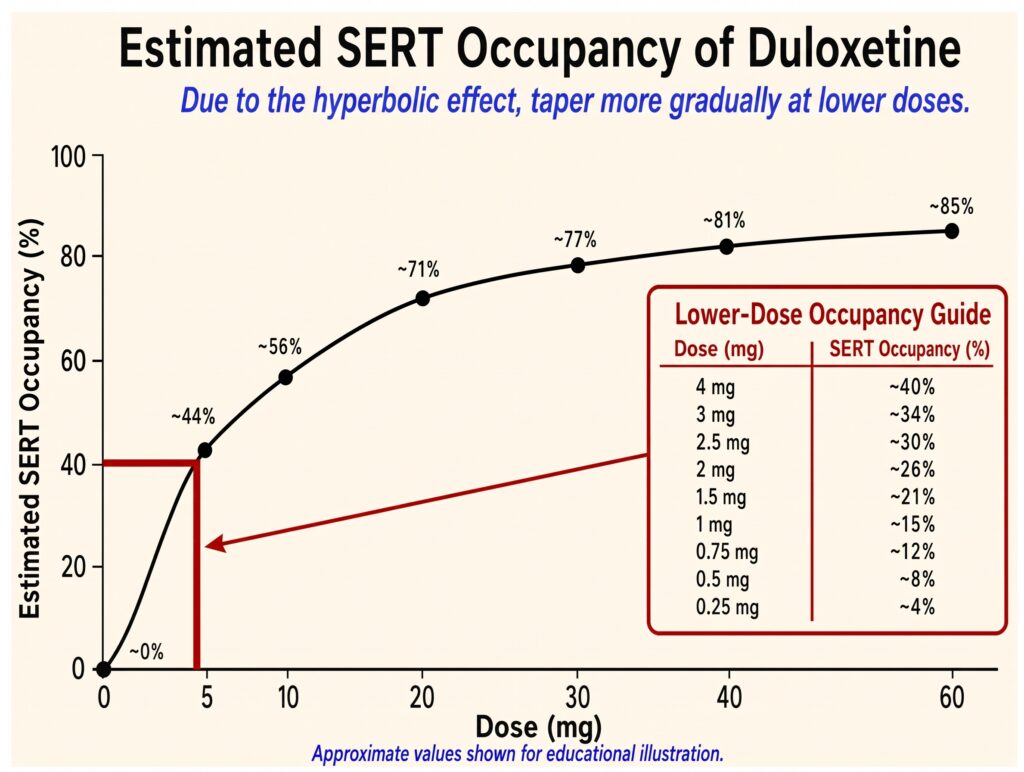
Sørensen, A., Ruhé, H. G., & Munkholm, K. (2022). The relationship between dose and serotonin transporter occupancy of antidepressants—a systematic review. Molecular Psychiatry, 27, 192–201. https://doi.org/10.1038/s41380-021-01285-w Horowitz, M., & Taylor, D. (2024). Duloxetine. The Maudsley Deprescribing Guidelines Antidepressants, Benzodiazepines, Gabapentinoids and Z-drugs (First, pp. 203–208). John Wiley & Sons
What Works: Hyperbolic Taper
A hyperbolic taper means making dose reductions that gradually decrease with each step. In the Cymbalta Hurts Worse peer support group, we recommend a 5% or less reduction from the previous dose–not the original dose. Years of lived experience has shown that higher percentage reductions are often too large and can trigger withdrawal symptoms for many people.
The hyperbolic taper that we suggest is a slow, steady reduction based on a simple rule: reduce by no more than 5% of your current dose every two weeks or longer. Not 5% of your starting dose–your current dose.
Each step gets smaller as you reduce, and that is on purpose. It allows your brain to adjust slowly to each lower dose. A complete taper from 60mg typically takes 2 to 4+ years. That is not a mistake. This is what works for MOST people. There are a rare few people who MAY be able to taper faster.
You need a taper plan, but you also need to stay flexible. Your body may not follow the schedule exactly, and you may need to slow down, hold at one dose for a while, or adjust your dose as you go. Listen to your body! We have free online calculators that can help you start a taper or adjust your dose along the way. You can use the Counting Method or Weighing Method to measure your doses at home. Full instructions are on this site.
Start here: Want-to-stop | Calculators
Already Stopped and Struggling?
If you stopped too fast, went cold turkey, or made reductions that were too large, you are not broken. What you are feeling is real. It is not a weakness, and it may not be a relapse. It can happen when an antidepressant drug is removed too quickly from a brain and body that have adapted to it. There are options, including reinstatement at a lower dose if you stopped recently. Go to: Stopped-and-struggling |
⚠ If You Are in Crisis Right NowIf you are having thoughts of harming yourself, call or text 988 (US Suicide & Crisis Lifeline) or go to your nearest emergency room. Severe withdrawal from duloxetine can cause suicidal thoughts. This is a known, documented side effect. It does not mean you will always feel this way. |
About This Site
This site does not provide medical advice. We are not doctors or licensed health professionals. Nothing here replaces the care of a qualified provider. The information presented comes from over a decade of documented member experience and the published work of recognized deprescribing researchers. Never stop or change a prescribed medication without careful consideration of the risks.
Where to Go Next
- Want-to-stop — Ready to taper. Start here.
- Stopped-and-struggling — Already off the drug and feeling bad.
- Considering-an-antidepressant — Thinking about starting duloxetine.
- Calculators — Build your taper schedule.
- From-CHW-successes — Read stories from people who made it through.