

What is Reintstatement and Updosing?
Reinstatement and updosing are two different things, and it is important to understand the difference.
Reinstatement is going back on a dose of Cymbalta/duloxetine after you have completely stopped taking it. The reinstatement dose depends on how long you have been off the medication, the dose you stopped from, your symptoms, and your recent dosing history.
Updosing means increasing your dose while you are still taking Cymbalta/duloxetine. This may be considered if withdrawal symptoms begin after a dose reduction that was too large or tapered too fast.
The goal of both is to reduce withdrawal symptoms and give the nervous system a chance to settle. The approach depends on whether you have completely stopped Cymbalta/duloxetine or are still taking it.
Reinstatement of Cymbalta/duloxetine
Stopping Cymbalta/duloxetine too fast can cause withdrawal symptoms. This can happen after stopping the drug, lowering the dose too quickly, skipping doses, or taking it every other day.
Reinstatement does not work the same way for everyone. How long you have been off the drug, your last dose, your recent dose changes, other medications, and your symptoms all matter.
Do not make a large dose change on your own. If possible, work with a healthcare provider who understands antidepressant tapering and managing withdrawal symptoms.
The moderating team on the peer support Facebook group Cymbalta Hurts Worse 2.0 and Reddit are available to suggest next steps.
Terms to Know
- Cymbalta/duloxetine = Cymbalta is the brand name. Duloxetine is the generic name. They contain the same active drug.
- Reinstatement = restarting a consistent daily dose of Cymbalta/duloxetine after stopping it.
- Late reinstatement = restarting Cymbalta/duloxetine after being off the drug for a longer period. At Cymbalta Hurts Worse, we often use this term when someone has been off longer than about 2–3 weeks.
- Updosing = increasing the dose while you are still taking Cymbalta/duloxetine because withdrawal symptoms started after a dose reduction.
- Stabilize = reaching a steady baseline after withdrawal symptoms have improved. Symptoms may not be completely gone, but they are more manageable and are no longer changing from day to day.
- Withdrawal = symptoms that can happen after lowering, skipping, or stopping Cymbalta/duloxetine.
- Post-Acute Withdrawal Syndrome (PAWS) = withdrawal symptoms that continue for many weeks, months, or even years. It is also sometimes called Protracted Withdrawal Syndrome or PWS.
- Bridging = adding another antidepressant while quickly reducing, abruptly stopping or switching from Cymbalta/duloxetine to the new antidepressant. Cymbalta Hurts Worse does not recommend bridging as a way to prevent withdrawal symptoms.
- Every-other-day dosing = taking Cymbalta/duloxetine one day and skipping it the next. This approach is likely to cause significant withdrawal symptoms.
- Yoyoing = changing the dose up and down several times over a short period. This can cause withdrawal symptoms.
Why Is Reinstatement Used?
Reinstatement may help reduce withdrawal symptoms after Cymbalta/duloxetine has been completely stopped.
Current duloxetine prescribing information and NICE guidelines both recognize restarting the medication as an option when withdrawal symptoms are severe. Reinstatement does not work for everyone, and the response can vary.
Important: Please read the full reinstatement instructions before making any dose change. Do not simply restart your previous full dose, especially if you have been off Cymbalta/duloxetine for more than two to three weeks.
Reinstatement Soon After Stopping
Our peer-support experience suggests that reinstatement is often more predictable when it takes place soon after stopping Cymbalta/duloxetine. However, responses to reinstatement tend to vary considerably.
At Cymbalta Hurts Worse, we have traditionally used about 2–3 weeks after stopping as an important time period. Some people may respond to reinstatement later. Others may not.
The longer a person has been off Cymbalta/duloxetine, the more carefully reinstatement should be considered.
Reinstatement may:
- Reduce or stop withdrawal symptoms
- Help only some of the symptoms
- Have little or no effect
- Cause new symptoms or make symptoms worse
Because the response cannot be predicted, the person’s full medication and withdrawal history should be considered.
Late Reinstatement
It is considered late reinstatement when someone has been off Cymbalta/duloxetine longer than about two to three weeks.
Late reinstatement is much less predictable.
There is no proven formula that tells us:
- how long someone can be off and still benefit from reinstatement
- what dose should be used
- who will react badly
Reinstatement does help a majority of people when all these factors are considered.
Researcher Anders Sørensen, PhD, has also discussed this uncertainty. Many people appear to improve after reinstating. A few do not improve and some may become more sensitive to the medication.
Because of this, someone who has been off Cymbalta/duloxetine for several weeks or months should not simply restart their former full dose on their own.
A person’s time off the medication, previous dose, withdrawal symptoms, other medications, and past reactions should all be considered.
Cymbalta Hurts Worse moderators can share peer-support information and lived experience, but we do not prescribe medication.
Updosing During a Taper
Updosing is different from reinstatement.
With reinstatement, the person has stopped Cymbalta/duloxetine and begins taking it again.
With updosing, the person is still taking Cymbalta/duloxetine but developed withdrawal symptoms after lowering the dose.
If symptoms begin after a reduction, returning to the last dose that was well tolerated may sometimes help.
Current guidance supports slowing or reversing a taper when significant withdrawal symptoms appear.
The goal is to find a dose that allows the nervous system to settle before making another reduction.
Large changes up and down should be avoided whenever possible.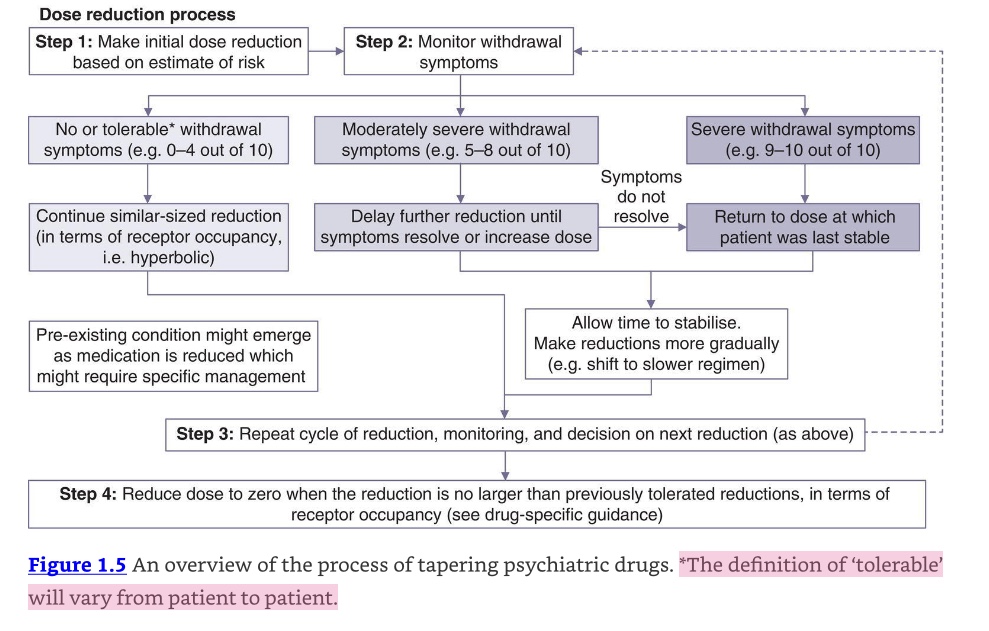
Horowitz MA, Taylor DM. The Maudsley Deprescribing Guidelines: Antidepressants, Benzodiazepines, Gabapentinoids and Z-drugs. Wiley-Blackwell; 2024. Figure 1.5, p. 49.
Horowitz MA, Taylor D. Tapering of SSRI treatment to mitigate withdrawal symptoms. The Lancet Psychiatry. 2019;6(6):538–546. doi:10.1016/S2215-0366(19)30032-X.
What if Cymbalta/duloxetine Was Stopped Suddenly?
Stopping Cymbalta/duloxetine suddenly can cause withdrawal.
The current duloxetine prescribing information recommends gradually reducing the dose instead of stopping abruptly. Abruptly can be interpreted as stopping all at once, over a several months or even rapid tapering.
If severe symptoms begin after suddenly stopping, reinstatement may be considered.
However, the best approach depends on:
- how long you have been off Cymbalta/duloxetine
- the dose you stopped from
- whether you had already been tapering
- whether other medications were started
- the symptoms you are having
A person who stopped recently may be in a very different situation from someone who has been off for several weeks or months. Reinstatement, as discussed above, may be able help provide relief from withdrawal symptoms.
What if You Were Skipping Days or Changing Doses?
Cymbalta/duloxetine is meant to be taken consistently.
Taking it every other day can cause large changes in the amount of medication in the body. Some people may feel withdrawal symptoms on the days they do not take it.
Changing the dose up and down can also make it harder for the nervous system to adjust.
When this has happened, the goal is to return to a consistent daily dose rather than continuing to skip days.
The right daily dose depends on the person’s recent dosing history. There is no single formula that is right for everyone.
Example: Taking 20 mg every other day averages 10 mg per day. A consistent 10 mg daily dose may help with stabilization.
What if Another Antidepressant Was Added?
This can make reinstatement more complicated.
Adding another antidepressant does not prevent Cymbalta/duloxetine withdrawal symptoms.
It can also become harder to know which symptoms are caused by:
- Cymbalta/duloxetine withdrawal
- the new medication
- side effects
- medication interactions
Some antidepressants and other medications affect serotonin. Taking more than one serotonin-raising medication can increase the risk of serotonin syndrome.
For this reason, medication combinations should be reviewed with a knowledgeable healthcare provider or pharmacist. It is helpful to also use a drug interaction checker.
After Reinstatement
If reinstatement helps, do not rush into another taper.
Give your nervous system time to settle. Listen to your body!
Being stable does not always mean having no symptoms at all. For many people, stability means they have returned close to the way they felt before the dose change that caused withdrawal.
Look for symptoms that are:
- much improved
- fairly steady
- no longer getting worse
At Cymbalta Hurts Worse, our peer-support approach has been to hold the same dose until you feel stabilized. After stabilization, wait several weeks before starting to taper again.
When tapering begins again, smaller reductions and longer holds may be needed.
Reinstatement Has Risks
Reinstatement can help some people, but it is not risk-free.
Starting, stopping, increasing, decreasing, or combining medications can sometimes cause serious reactions.
This is one reason large and repeated dose changes should be avoided.
Reinstatement may be especially difficult once a person has been off Cymbalta/duloxetine for a longer time or has already had several dose changes or medication reactions.
Research on late reinstatement is limited. There is no test that can tell us ahead of time whether it will help. It is our peer support and lived experience that reinstatement does help a majority of people.
What Is Protracted Withdrawal?
Sometimes withdrawal symptoms continue long after the first weeks following a reduction or stopping the medication.
This is often called Post-Acute Withdrawal Syndrome (PAWS) or Protracted Withdrawal Syndrome (PWS).
Symptoms can affect sleep, mood, thinking, balance, digestion, muscles, the senses, and many other parts of the body.
There is no set timeline for recovery. Some people improve within months. Others have symptoms for much longer.
Research has also not found a treatment that reliably stops protracted withdrawal. Late reinstatement may help some people but may not help others.
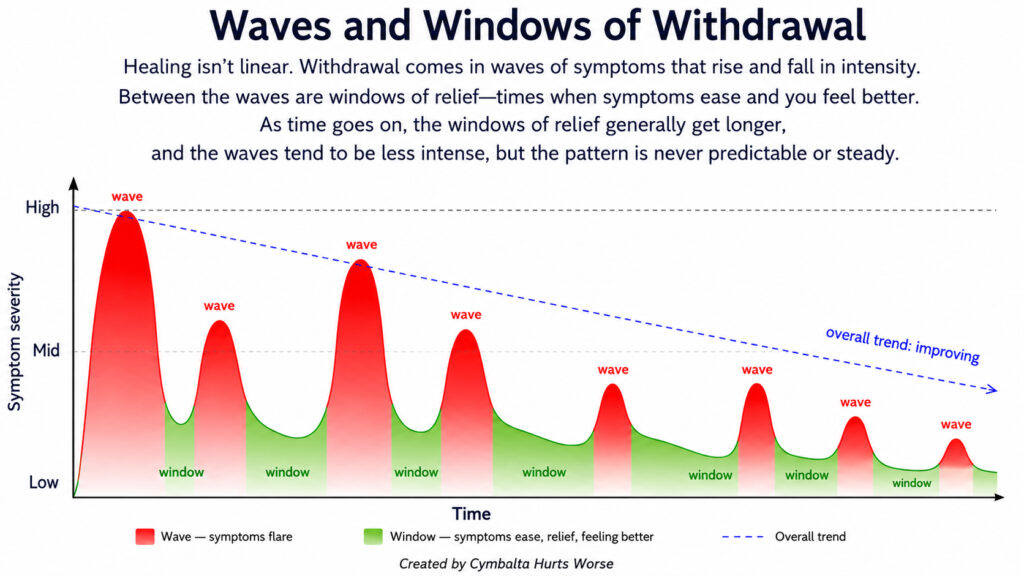
Recovery often happens slowly and may include waves and windows — periods when symptoms are worse followed by periods when symptoms improve.
When to Get Medical Help
Some symptoms need medical attention.
Seek urgent medical care for symptoms such as:
- seizures
- severe confusion
- fainting
- very high fever
- severe muscle stiffness
- extreme agitation
- new suicidal, homicidal or violent thoughts
- symptoms that feel dangerous or life-threatening
Do not assume every new symptom is caused by withdrawal. Other medical problems can happen at the same time and may need treatment.
Important
Reinstatement is not an exact science.
There is no single dose, timeline, or method that works for everyone.
Current medical guidelines recognize that restarting or returning to a previous antidepressant dose may help severe withdrawal symptoms. However, research on late reinstatement and protracted withdrawal is still limited.
Cymbalta Hurts Worse provides education and peer support based on published research and lived experience. We do not diagnose, prescribe medications, or replace medical care.
References
- DailyMed — Duloxetine Delayed-Release Capsules
Current U.S. prescribing information for generic duloxetine. It recommends gradual dose reduction and states that restarting the previous dose may be considered if severe withdrawal symptoms occur.
Duloxetine Prescribing Information — DailyMed - NICE — Depression in Adults: Treatment and Management
NICE guidance says that if antidepressant withdrawal symptoms are severe, restarting the original antidepressant at the previous dose may be considered. Once symptoms improve, a slower taper with smaller reductions may be used.
NICE — Starting and Stopping Antidepressants - Royal College of Psychiatrists — Stopping Antidepressants
A patient-friendly guide explaining antidepressant withdrawal, slower tapering, and what to do if symptoms appear after a dose reduction or after stopping. It discusses returning to a previously tolerated dose and then tapering more slowly.
Royal College of Psychiatrists — Stopping Antidepressants - Horowitz M, Perry T. — “Stopping Antidepressants Safely” (2026)
Discusses safer antidepressant tapering, withdrawal symptoms, individualized tapering, and the use of smaller dose reductions as the dose becomes lower. It also addresses adjusting or reversing a taper when withdrawal becomes difficult.
Horowitz & Perry 2026 — PubMed - Framer A. — “What I Have Learnt From Helping Thousands of People Taper Off Antidepressants and Other Psychotropic Medications” (2021)
Describes lessons learned from many years of peer-support experience. The article discusses withdrawal, nervous-system sensitivity, slow tapering, and cautious reinstatement when withdrawal symptoms develop.
Framer 2021 — PubMed Central - Sørensen AK, Jørgensen KJ, Munkholm K. — Antidepressant Tapering Guidelines: A Systematic Review (2022)
Reviews clinical guidelines for stopping antidepressants and finds that many provide limited practical guidance about withdrawal and tapering. It highlights the need for clearer, more individualized recommendations.
Sørensen et al. 2022 — PubMed Central - Rennwald A, Hengartner MP. — “Post-Acute Withdrawal Syndrome After Stopping Antidepressants: A Systematic Review” (2025)
Reviews evidence about prolonged antidepressant withdrawal. It shows that symptoms may continue for months or longer and that there is still limited evidence about treatments, including late reinstatement.
Rennwald & Hengartner 2025 — PubMed
###