

METHODS OF TAPERING
A Hyperbolic or Gradual Way to Lower Your Dose
This page explains how some people lower their duloxetine dose by counting the small beads inside the capsule.
After many years of running the Cymbalta Hurts Worse peer support group, with more than 45,000 members, we learned that many people need to taper very slowly. This is called the Hyperbolic Taper Method.
This page is for education only. It is not medical advice. Click here for suggestions on how to talk to your provider.
Important Safety Information
Do not suddenly stop taking duloxetine unless you have an urgent medical reason such as Serotonin Syndrome.
Stopping too fast can cause withdrawal symptoms. These may include dizziness, nausea, anxiety, sleep problems, brain zaps, mood changes, pain, sweating, or other symptoms. Some people have mild symptoms. Others may have severe or long-lasting, life changing withdrawal symptoms.
Bead counting is an off-label tapering method. This means it is not included in the official instructions for duloxetine.
The FDA-approved label says to swallow the capsule whole and not open, crush, or chew it because this may damage the special delayed-release coating. Our tapering methods maintain the delayed-release coating. Never crush or chew the beads. (FDA Access Data)
Three Ways to Make Smaller Doses
There are three main ways to make the small doses needed for a slow taper:
- Counting beads
- Weighing beads
- Using a compounding pharmacy
This page explains the popular counting method.
Weighing as an Alternative
Counting hundreds of beads can take a long time.
Some people choose to weigh the beads instead. Weighing may be faster when the dose still contains many beads.
When you get down to small amounts, they may be too light for an affordable (US$30-50) home scale to measure well. At that point, you will need to count the beads or use a compounding pharmacy.
Learn more on our Weighing Duloxetine Beads page.
What Is a Hyperbolic Taper?
A hyperbolic taper lowers the dose in small steps. Each new dose is based on the dose you are taking now—not the dose you took when you began.
For example, a 5% reduction means lowering your current dose by 5%. The next reduction is then 5% of that new, smaller dose.
This makes each reduction smaller as the dose gets lower. This is called a proportional or hyperbolic taper.
A small dose can still have a strong effect. Because of this, many people need smaller reductions near the end of their taper.
How Fast Should You Taper?
There is no perfect taper rate for everyone. Our community usually suggests starting with a reduction of no more than 5% of your current or most recent dose.
Many people taking duloxetine find that a 5% reduction is too large. Starting with a smaller reduction such as 2.5% or 3% lets you see how your body responds.
We suggest holding the first reduction for three to four weeks. This gives you time to watch for delayed symptoms.
After that, hold each new dose for at least 14 days. Many people need to hold longer.
Do not lower your dose again just because 14 days have passed. Wait until any withdrawal symptoms have improved or become manageable.
Official guidance also recognizes that some people need reductions of about 5% every two to four weeks and that tapering may take many months or even a few years. The pace should be changed based on the person’s symptoms.
Listen to Your Body
Your taper schedule is just a starting point. It is not a deadline.
As your dose gets lower, you may need to:
- Make smaller reductions
- Hold the dose longer
- Pause the taper
- Seek peer support from our Cymbalta Hurts Worse Reddit Community
Do not keep lowering the dose when symptoms are getting worse.
The goal is not to finish as fast as possible. The goal is to lower the dose at a rate your nervous system can handle.
Here is a visual guide that many people find helpful during their taper.
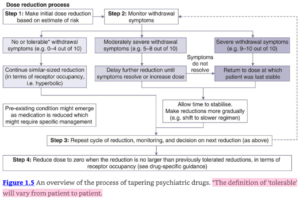
Before You Begin
Before starting your taper:
- Take the same dose at the same time each day. Consider setting a daily alarm.
- Avoid starting during a major crisis or life change.
- Read the preparation information on this website.
- Track your progress on a calendar or journal to recognize patterns with your taper and to log successes.
- Gather your supplies.
Not everyone will feel completely symptom-free before tapering. The goal is to begin from the most stable place that is possible for you.
The Calculators
The automated calculators are online here:
https://healthwithoutantidepressants.com/calculators/
You have the choice of an online calculator that you can setup and print, or an Excel spreadsheet that you can run in Excel or Google Sheets, your choice.
Tools You May Need
- A clean surface
- A clean tray, dark towel or t-shirt, or dark microfiber cleaning cloth
- A bead-counting tray, tool or mat–some people use a jewelry tray
- A small scoop or folded piece of paper
- Tweezers
- Empty capsules
- Small dark containers with labels to store the beads away from light
- A notebook or taper journal
- A calculator or printed taper schedule
Keep all beads and prepared capsules dry and away from children and pets.
Capsule Sizes
Empty capsules come in different sizes. Choose a capsule that can hold your counted beads and is easy for you to swallow.

Beads to Use
Use only clean, dry, and unbroken beads.
Do not use beads that are:
- Crushed
- Chipped
- Wet
- Sticky
- Damaged
- Fused together
- Undersized
You need duloxetine capsules which contain many small beads. Capsules that contain larger pellets or small tablets are not appropriate for tapering. If the beads are not fairly similar in size, counting may not give a steady dose. Weighing or professional compounding may be a better choice.
Save all extra usable beads in a labeled air tight and dark container. These should be used in your next batch of prepared capsules. Keep the chipped or fused beads in a separate air tight and dark container and set aside.
Always refill your prescription at your usual refill time. Even as you taper lower, you should still continue to refill your prescription in case of supply chain issues.

Step 1: Find the Average Bead Count
The number of beads may be different in each capsule. Using an average helps to ensure the dose is consistent.
You do not need to count the beads again with every refill. You only need to find a new average bead count if:
- The manufacturer or brand changes
- The beads look noticeably different
- The capsule strength changes
For example, you will need a new average bead count if you were using 60 mg capsules and then change to 30 mg capsules.
Before making your taper schedule:
- Open one capsule
- Count every bead
- Write down the total
- Repeat this with two more capsules
- Enter all three totals into the taper calculator
The taper calculator will find the average for you.
Always count capsules from the bottle you are currently using.
Step 2: Choose a Starting Rate
Choose a starting reduction between 2.5% and 5%.
A smaller starting rate may be better when you:
- Have had withdrawal symptoms before
- Have taken duloxetine or other psychiatric medications for many years
- Are already having symptoms
- Are very sensitive to medication changes
- Have had a history of starting or stopping psychiatric medications
- Are near the lower part of your taper
- Are tapering another medication
Step 3: Use the Taper Calculator
Our calculators are available on the Tapering Calculators page.
You may use:
- The online calculator
- The Excel spreadsheet
- Or a printed copy of the Excel spreadsheet or online calculator
Enter the bead counts from three capsules. The calculator will find the average and tell you how many beads to take at each step.
Print the full schedule. Use a pencil to record:
- The date you begin each dose
- Your symptoms
- Any long holds
- Any changes to the plan
- The manufacturer and bottle information, which is printed on the pharmacy label, sometimes in tiny print.
The calculator gives you a starting schedule. You may need to slow down based on how you feel.
Step 4: Count the Beads You Take
Always count the beads you will take.
Do not count only the beads you remove.
Each original capsule may contain a different number of beads. Counting the beads you take helps you follow your taper plan and take a consistent amount each day.
To prepare a dose:
- Wash and dry your hands
- Work on a clean, dry surface
- Gently twist the capsule open
- Pour all the beads onto your counting surface
- Count the number of beads shown on your taper schedule
- Scoop those beads into an empty capsule (see picture below)
- Close the capsule
- Place in your pill organizer or storage bottle
Do not crush, chew, dissolve, or mix the beads with food or liquid.
Step 5: Prepare Several Doses
Counting beads takes time at first. It will become easier with practice.
You may prepare several capsules at one time. Some people prepare a few days or one week at a time.
Helpful ideas:
- Refrigerate beads for one hour prior to counting to reduce static
- Listen to music or a podcast or work in a quiet place
- Ask a trusted person to help
- Consider using a daily pill organizer
- Stop and take a break if you become tired
- Avoid ceiling fans
- Refrigerate beads for one hour prior to counting to reduce static
- Keep pets away from bead counting area
Accuracy is more important than speed.

Step 6: Hold the Dose
Hold your first reduced dose for 21 to 28 days.
After the first reduction, hold each dose for at least 14 days, or longer when needed.
Withdrawal symptoms may not begin right away. A longer first hold gives you time to see how your body reacts.
Resist the urge to speed up when the first few reductions feel easy. Symptoms can become stronger later, especially as the dose gets lower.
Step 7: Keep a Taper Journal
Keep a simple record of your taper. You do not need to write in it every day. Always note your average bead count including the original capsule dose.
Some people only record:
The date
Their bead count or dose
The date and percentage of each reduction
This may be enough to track the taper without focusing too much on symptoms.
You may also choose to note briefly:
Changes in sleep or symptoms
New prescription or over the counter medications
Illness, stress, travel, or major life events
Positive moments or small successes
Try not to focus only on difficult symptoms or negative feelings. Be aware of them, write down what may be helpful, and then move on.
Your journal can help you see patterns and decide whether to make the next reduction, hold your dose longer, or make a smaller reduction.
When to Slow Down
Consider pausing the taper when:
- Symptoms are getting stronger
- You are having several new symptoms
- You cannot complete normal daily tasks
- Your sleep is getting much worse
- You are facing a major illness or crisis
- You recently changed another medication
- You do not feel ready for the next reduction
Holding is part of tapering process. It is not failure.
When to Seek Help
Contact your knowledgeable prescriber when symptoms are severe, frightening, or hard to manage. Seek peer support on Cymbalta Hurts Worse 2.0 on FB, or on Reddit at r/cymbaltahurtsworse.
Get urgent help for:
- Thoughts of suicide or self-harm
- Severe confusion
- Fainting
- Seizures
- Dangerous behavior or emotions such as rage, anger, or severe irritability
- Signs of an allergic reaction
- Any symptom that may be a medical emergency
Withdrawal can sometimes look like a return of anxiety, depression, pain, or another health condition.
Counting Video
A video showing one method of counting beads is available here:
The Most Important Points
- Start with a small dose reduction.
- Calculate each reduction from your most recent dose.
- Count the beads you take, not the beads you remove.
- Hold each dose long enough to see how your body responds.
- Make smaller reductions and longer holds when symptoms appear.
There is no prize for finishing quickly. A careful taper may take many months or years. Your body—not the calendar—should guide the pace.
Educational Disclaimer
This information is for education and peer support only. It does not replace medical care. Do not start, stop, or change a prescription medication without discussing the risks and options with a knowledgeable healthcare professional.
###