

The pattern
Most people expect recovery to follow a straight line – like a broken bone with a predictable timeline. Antidepressant withdrawal doesn’t work that way. Every case is different. Symptoms vary by person, and so does how long they last.
The wave/window pattern is typically caused by stopping the antidepressant too quickly. In some cases, you may experience wave and windows even with a hyperbolic taper, though typically with less severity.
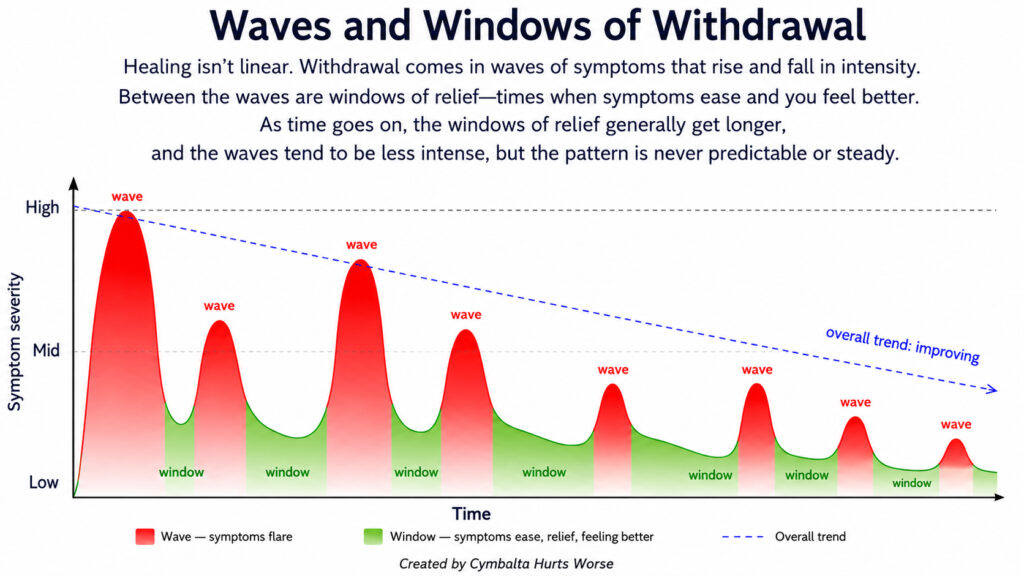
What many people experience instead is a cycle:
periods when symptoms are bad – waves
periods when they ease up – windows
Early on, symptoms may feel constant. Over time, they tend to organize into this pattern. There’s no predictable schedule – but knowing the pattern exists helps.
Waves
A wave is when symptoms flare. They can be physical, emotional, or both.
If you pay attention, you’ll often notice warning signs before a wave hits – a shift in mood, rising anxiety, early physical discomfort. Keeping a detailed journal helps you recognize these signals and learn from them over time.
Waves may bring anxiety, depression, migraines, emotional overwhelm, and more. It helps to break a wave into stages: the warning signs, the peak, and the fade. Once you can see those parts clearly, you can find ways to manage each one.
Physical symptoms often show up first as warnings. For joint pain or headaches, standard over-the-counter painkillers can help. For dizziness, rest and staying still usually work best.
Emotional symptoms are harder. During a wave, thoughts that feel rational may not be. Anxiety, depression, and dark impulses – including thoughts of self-harm – can feel convincing in a way they normally don’t. The key is recognizing that these thoughts are wave-driven, not reflections of who you are.
Windows
A window is when symptoms ease. The first time it happens, it can feel like it’s finally over. It’s not, but it is real relief – and it’s time you can use.
In a window, notice how you think. Pay attention to what feels like you – how you respond to things, where your mind naturally goes. That awareness becomes a resource during the next wave. When a dark or irrational thought appears, you’ll be able to recognize it as out of character and let it pass.
Most people find that windows gradually lengthen and waves gradually shorten. Progress is slow, but it happens.
Mindfulness
The more you can use mindfulness during waves, the shorter they tend to become. Our minds run on feedback loops – one thought leads to another. Mindfulness lets you interrupt that loop.
Over time, you learn to distinguish wave-thoughts from your real thoughts and feelings. Eventually, a final window comes, and the waves stop.
Is it withdrawal – or something else?
Withdrawal symptoms can mimic other conditions: fibromyalgia, MS, bipolar disorder, GAD, depression, anxiety, and more. It can be hard to tell the difference.
Never stop antidepressants abruptly or reduce your dose quickly. Always taper gradually, ideally with medical guidance.
Useful reading:
- BBC: Antidepressant withdrawal
- BBC: Coming off antidepressants
- WebMD: Antidepressant withdrawal
- Harvard Health
- Mayo Clinic
- Royal College of Psychiatrists
Common withdrawal symptoms
This is not a complete list:
- Inner restlessness, inability to stay still (akathisia)
- Sleep problems, unusual dreams, nightmares
- Dizziness, light-headedness, poor balance
- Sweating, flushing, poor heat tolerance
- Nausea, vomiting, cramps, diarrhea, appetite changes
- Numbness or pain; sensitivity to sound; “brain zaps”
- Irritability, anxiety, confusion, mood swings, agitation, paranoia
- Tremors, restless legs, coordination problems
- Fatigue, flu-like symptoms
- Crying spells, thoughts of self-harm
- Visual disturbances (blurry vision, double vision, trailing)
- Heart palpitations, tinnitus, blood pressure changes
With thanks to Npanth: Waves and Windows in SSRI Withdrawal
###